Dr. Ong Wee Jun Named as Young Chemists 2020 by Chemistry–A European Journal
Published on October 22, 2020
The Research Management Center congratulates Associate Professor Dr. Ong Wee Jun from XMUM School of Energy and Chemical Engineering on his recent accomplishment of being highlighted and featured in the 2020 Young Chemists of Chemistry – A European Journal, a prestigious journal under Wiley-VCH on behalf of Chemistry Europe with a latest impact factor of 4.857. The Young Chemists 2020 Special Collection features young and emerging scientists from around the world.
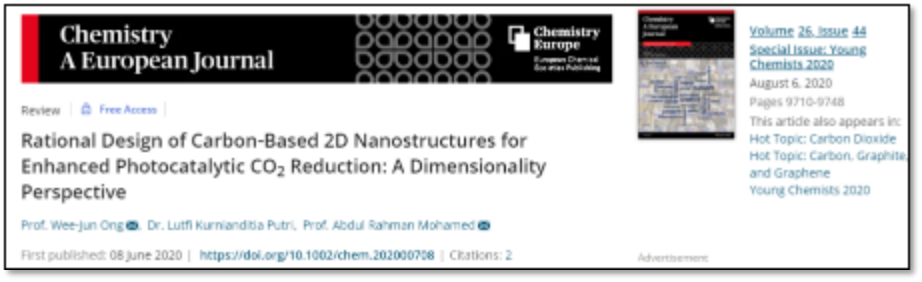
In recognition of this achievement, Assoc. Prof. Dr. Ong was invited to publish the paper entitled “Rational Design of Carbon‐Based 2D Nanostructures for Enhanced Photocatalytic CO2 Reduction: A Dimensionality Perspective”, as first author and corresponding author, in Chemistry – A European Journal. His invited work has also been featured as the Frontispiece of this special issue.
Image
This work, which was done in close collaboration with scientists from Universiti Sains Malaysia (USM), was inspired by the natural photosynthesis in plants to overcome the greenhouse gas and global warming. Since the 20th century, the global atmospheric concentrations of CO2 had increased drastically from 280 to 379 ppm due to the enhancement of human activities since the advent of Industrial Revolution. Among the CO2 reduction methodologies, photocatalytic reduction using synthetic systems has become a trendy research topic. Unlike the high energy input requirement for carbon capture and storage (CCS), the photocatalytic reduction using solar energy as input energy is deemed as a more feasible, cost‐effective and environmentally friendly approach.
The past decade has witnessed an impetus in the rise of two‐dimensional (2D) advanced nanomaterials to boost catalytic activities. In particular, the use of 2D carbon‐based materials is deemed as highly favorable, not only as a green material choice, but also due to their exceptional physicochemical and electrical properties. In this work, the researchers have presented a diverse range of alterations and compositions derived from 2D carbon‐based nanomaterials, mainly graphene and graphitic carbon nitride (g‐C3N4), which have remarkably ameliorated the photocatalytic CO2 performance. The rational design of the photocatalytic systems with consideration of the aspect of dimensionality and the resultant heterostructures at the interface are analyzed to elucidate an insightful perspective on this subject.
Although a significant progress has been made in 2D materials development, research progress is still hindered by the lack of the in‐depth understanding on the detailed reaction mechanisms for photocatalytic CO2 reduction over carbon‐based 2D materials. To translate the CO2 photoreduction process to practical applications, it is indispensable that precise engineering of carbon‐based materials should be delved deeper to rationally design photocatalysts to achieve optimal photoactivity. Although research on photocatalytic CO2 reduction has not reached a desired performance for practical exploitation, it is anticipated that the fast‐paced development in the research area, the growing recognition of the reaction mechanisms and the rational design of carbon‐based 2D materials, should deliver the promise of this process coming closer to realization in years to come.
Image
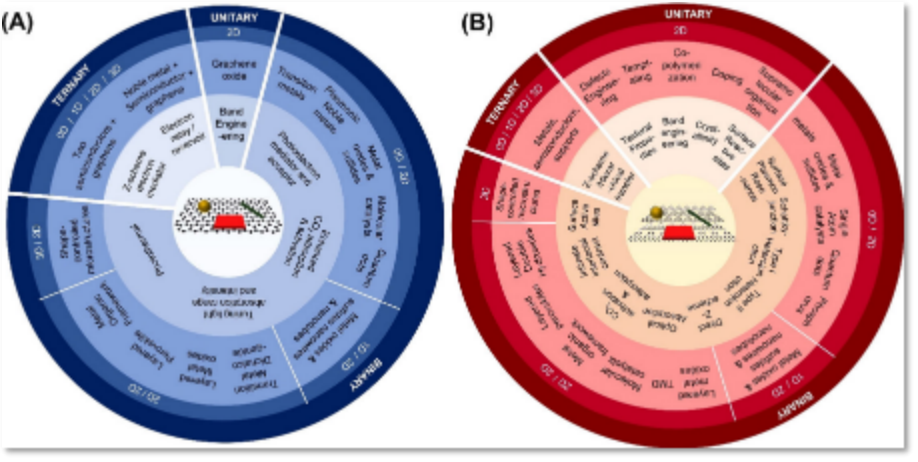
Summary of (A) 2D graphene‐based and (B) 2D g‐C3N4‐based photocatalysts categorized by their dimensionalities and the corresponding roles in the enhancement of CO2 reduction.
https://doi.org/10.1002/chem.202000708
Assoc. Prof. Dr. Ong Wee Jun is now an Associate Professor with the School of Energy and Chemical Engineering, XMUM. He has won several prestigious awards since joining XMUM in 2018, including the Merdeka Award Grant for International Attachment, Young Researcher Award from Institution of Chemical Engineers (IChemE) and the Green Talent Award presented by the German government. He was also named as a “Global Highly Cited Researcher 2019” by Clarivate Analytics (the Web of Science Group). Currently, he serves as the Chief Editor, Associate Editor, Guest Editor, and Board Member of Frontiers in Nanotechnology, Frontiers in Chemistry, Materials Horizons, Langmuir, Scientific Reports, and Nanotechnology, respectively. For more information about Dr. Ong, please refer to the following websites: