Vice President Zhang Ying Shares XMUM Experience at Tsinghua University
Published on May 29, 2025
Assoc. Prof. Dr. Zhang Ying, Vice President of Xiamen University Malaysia (XMUM), participated in the academic forum titled "The Internationalisation of Higher Education: Towards a New Landscape", held at Tsinghua University on 24 May 2025, and gave a speech.
Image
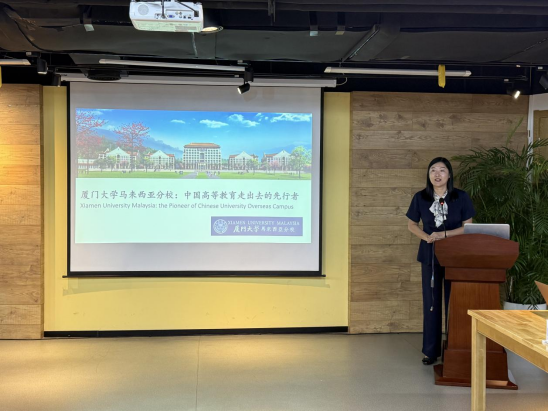
The forum was co-hosted by the School of Education and the Office of International Affairs at Tsinghua University. It brought together scholars and experts from institutions such as Hiroshima University, the University of Melbourne, the Chinese University of Hong Kong, Beijing Institute of Technology, and Northwestern Polytechnical University. Participants engaged in in-depth discussions on key topics including geopolitical change, international student mobility, and transnational education governance, attracting active participation from both faculty and students.
During the forum, Dr. Zhang Ying introduced Xiamen University Malaysia as an example of China's efforts to explore international engagement in higher education. She noted that XMUM has been recognised as a case of sustainable internationalisation, supported by both the Chinese and Malaysian governments.
As the first independent overseas campus established by a "Double First-Class" university, XMUM currently hosts over 9,100 students from Malaysia, China and more than 40 other countries and regions. Dr. Zhang Ying outlined three key features of XMUM’s development: its pioneering Gaokao admission policy for Chinese students, strong research performance with four disciplines ranked in the ESI global top 1%, and its commitment to cultivating globally-minded graduates through a multicultural learning environment.
She also highlighted the importance of institutional support and regional partnerships in achieving long-term sustainability for transnational education initiatives, especially within the context of the Belt and Road Initiative.
The forum provided a valuable platform for exchanging insights on the evolving landscape of higher education internationalisation, particularly in the face of challenges such as the COVID-19 pandemic, shifting geopolitical dynamics, and advances in artificial intelligence and other emerging technologies.