
Prof. Zheng Jin-Cheng Co-Authors Article in Nature Communications
Published on May 2, 2019
The Office of Research and Innovation congratulates Prof. Dr. Zheng Jin-Cheng on his recent publication entitled “Anomalous metal segregation in lithium-rich material provides design rules for stable cathode in lithium-ion battery.” The paper was published online on 9 April 2019 (volume 10 and article number 1650) in Nature Communications, a bimonthly peer-reviewed scientific journal published by Nature Publishing Group.
Prof. Zheng co-authored the paper with three leading groups in US and China, including Prof. Xin Huolin’s group at University of California, Irvine; Prof. Yang Xiao-Qing’s group at Brookhaven National Laboratory; and Prof. Yu Xiqian’s group at Institute of Physics, Chinese Academy of Sciences.
Image
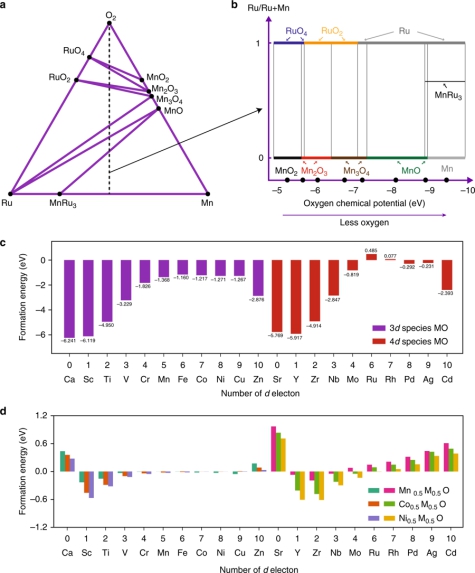
Ab initio calculation for ruthenium segregation and prediction for Mn/Co/Ni substitution that can stabilize the surface. (a) Ternary phase diagram showing the complete convex hull for the system. (b) Presentation of stable phases as a function of oxygen chemical potential phases along the bisecting line of the phase diagram. (c) Ab initio DFT calculation of the formation energy of metal-oxygen (MO) rock-salt structure. (d) Ab initio DFT calculation of the solubility of 3d/4d transition metals in MnO, NiO, and CoO..
The authors stated the significance of the work:
“Despite the importance of studying the instability of delithiated cathode materials, it remains difficult to underpin the degradation mechanism of lithium-rich cathode materials due to the complication of combined chemical and structural evolutions. Herein, we use state-of-the-art electron microscopy tools, in conjunction with synchrotron X-ray techniques and first principle calculations to study a 4d-element-containing compound, Li2Ru0.5Mn0.5O3. We find surprisingly, after cycling, ruthenium segregates out as metallic nanoclusters on the reconstructed surface. Our calculations show that the unexpected ruthenium metal segregation is due to its thermodynamic insolubility in the oxygen deprived surface. This insolubility can disrupt the reconstructed surface, which explains the formation of a porous structure in this material. This work reveals the importance of studying the thermodynamic stability of the reconstructed film on the cathode materials and offers a theoretical guidance for choosing manganese substituting elements in lithium-rich as well as stoichiometric layer-layer compounds for stabilizing the cathode surface.”
Prof. Zheng and his PhD student Mr. Cheng Hao, a visiting student at Xiamen University Malaysia in the year of 2018, contributed in designing the experiments, performing the ab initio calculations and accomplishing the XPS studies and analysis.
This paper is available online: https://doi.org/10.1038/s41467-019-09248-0
About Prof. Zheng Jin-Cheng
Prof. Dr. Zheng Jin-Cheng is honoured as Distinguished Professor of Minjiang Scholar’s Program at Xiamen University (China) in view of his contribution and commitment to the fields of Physics and Energy. He is currently serving as Advisor to the Office of Research and Innovation and Director of Institute of Artificial Intelligence (iAI) at Xiamen University Malaysia. Prof. Zheng, with h-index of 36 (based on Google Scholar), has published more than 150 peer-reviewed articles in SCI journals with a total citation of more than 4,000. He has supervised more than 20 doctoral and master’s students to date.
Prof. Zheng’s research interests and updates are available online: http://phys.xmu.edu.cn/physics/zheng-publication
Prof. Zheng is also the co-corresponding author of the first XMUM publication in Nature Communications: