Tan Ann Ngee: Bridging Worlds Through Languages
Published on September 3, 2026
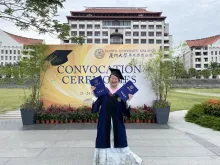
In this era of booming AI technologies, many have begun to question the value of language degrees. To explore this question, we sat down with Tan Ann Ngee, a 2026 English graduate from Xiamen University Malaysia (XMUM), to hear how language has shaped the way she understands people, work, and the world.

Growing up in Malaysia’s multilingual society, Ann Ngee came to see language as a living fabric woven through everyday life. For her, language has never been merely a subject, but a way of connecting with others. “I have loved reading since childhood. Although I attended a Chinese independent high school, I read more English books, so I decided to follow my heart and pursue what I was truly interested in.”
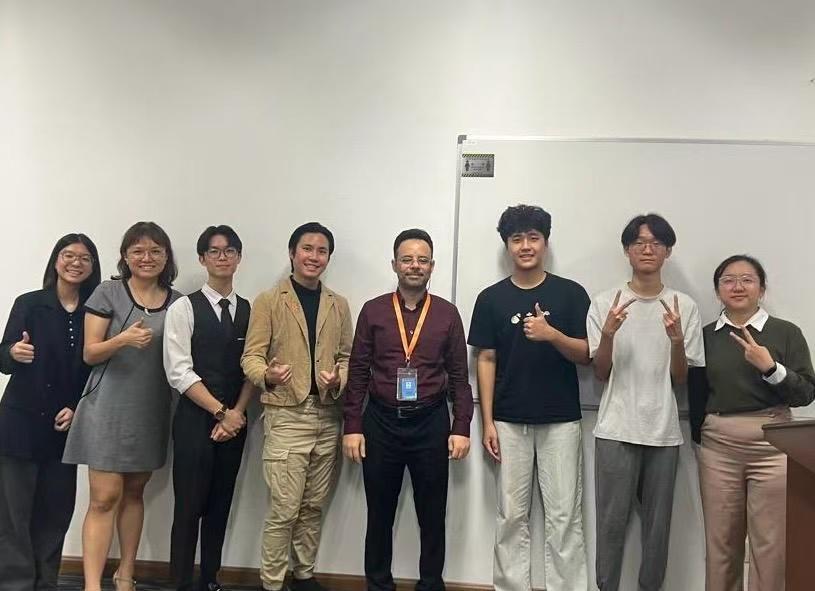
At university, she was guided and supported by Dr. Al-Saggaf Mohammadali Abdellah and Dr. Achoui Sana. “Whenever I had any ideas, the lecturers would listen carefully and then give practical advice from students’ perspective. Sometimes my thoughts were quite imaginative, but they never criticised me. Instead, they offered great encouragement. That feeling was very reassuring.”
One of her most memorable university experiences took place beyond the classroom. As part of a second-year poetry module, she and her friends went beyond the syllabus by waking before dawn to watch the sunrise on campus, hoping to experience the poet’s imagery firsthand.
“It was the first time I had seen XMUM at 5 a.m. Although we couldn’t watch a full sunrise due to the weather, we took turns reciting our favourite poems, which gave the moment its own charm.”
In February 2022, Ann Ngee took part in a short-term brochure translation project for a tyre factory. Through the project, she began to see translation as a form of bridge-building between people from different backgrounds. “If you translate jargon with 100% accuracy but bore the readers, the brochure itself becomes meaningless.”
For her thesis, she compared English and German by examining common errors among XMUM students and observing the differences between language systems. For instance, although English and German share some similar pronunciations, their spelling and grammar differ significantly.
“Of course, we can get by with satisfactory language skills, but if you are willing to explore the history, context, and culture behind a language, it offers another way of understanding the world.”
Her curiosity about language later led her to speech therapy. Her interest began when she learned about speech disorders caused by head trauma in an introductory linguistics class. It eventually brought her to a speech therapy internship, during which she participated in more than 200 therapy sessions.
She admitted that the experience helped her grow from a student who felt unfamiliar with clinical settings into an intern who could independently interact with children and complete simple treatment tasks.
The fast-paced work environment and the need to translate knowledge into practice were two major challenges. What impressed her most, however, was the importance of emotional connection between therapists and patients. “My work looks like playing with children, but it is actually using games to train their communication skills. Every response has something worth observing.”
She added, “Building a good relationship with them takes consistent effort over many therapy sessions, but when they make progress, you feel it is all worthwhile.”
Ann Ngee observed that although awareness of speech therapy in Malaysia has improved in recent years, the therapist-patient ratio remains severely imbalanced. This motivated her to learn more actively about the field and later take additional courses such as Phonetics and Phonology.
Ann Ngee embraces the idea of “work-life integration”, believing that work should be part of life rather than something entirely separates from it. “Rather than deliberately separating work and life, I think it is more important to let them complement each other. Since language appears everywhere in daily life, the new inspiration and insights that arise from it can also enrich work itself.”
As for the large language models (LLM) currently dominating the market, she remains optimistic. “The real value of a language degree lies in judgment, expressiveness, and the human touch.”
After graduation, Ann Ngee entered the aviation industry. “I don’t think I should stick to one possibility. That is why I remain open to new challenges.”
In her view, what matters more is to explore different industries and discover her true direction through real-life practice.