Prof. Dr. Ong Wee Jun and Team Publish Breakthrough in Applied Catalysis B: Environment and Energy
Published on April 22, 2026
The Research and Postgraduate Centre congratulates PhD candidate Joel Foo Jie, Prof. Dr. Ong Wee Jun, and their research team from the School of Energy and Chemical Engineering and the Center of Excellence for NaNo Energy & Catalysis (CONNECT) on their recent publication in Applied Catalysis B: Environment and Energy. With a latest Impact Factor of 21.1, Applied Catalysis B: Environment and Energy is a highly prestigious scientific journal renowned for featuring world-class research in environmental and sustainable sciences.
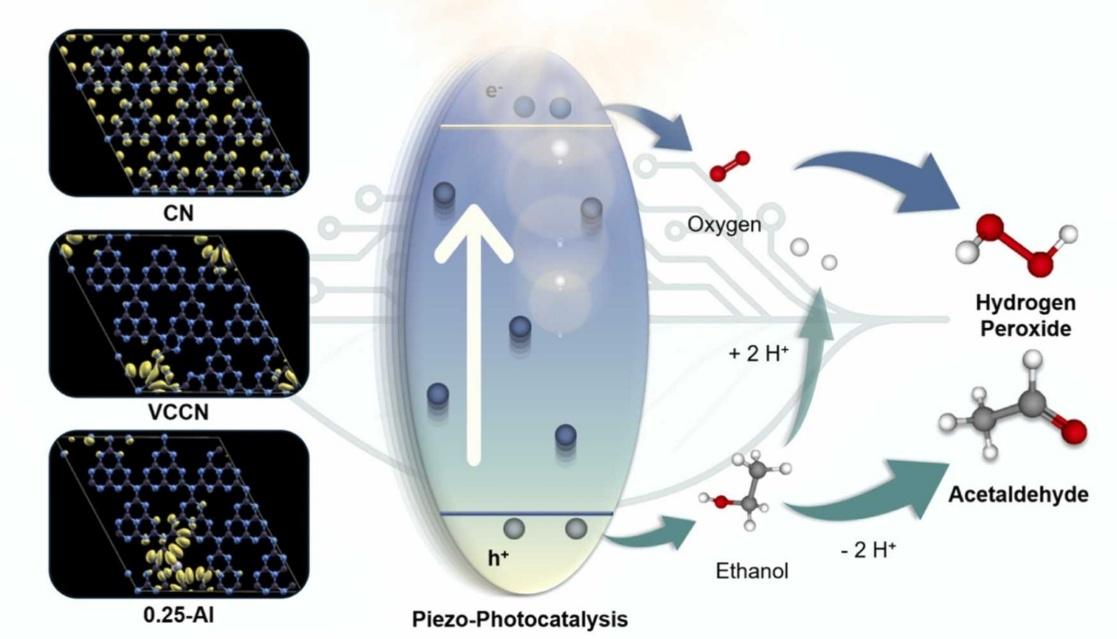
The published article, titled “Modulating Lattice Polarization in Crystalline Carbon Nitride via Vacancy-Anchored Aluminum for Simultaneous Piezo-Photocatalytic H2O2 and Acetaldehyde Synthesis", tackles a major challenge in creating a truly sustainable chemical industry.
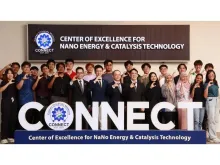
Currently, producing essential industrial chemicals like hydrogen peroxide (a vital, environmentally friendly cleaning and bleaching agent) requires a massive amount of energy and relies on complex, heavy-industry processes. Led by first author and PhD candidate Joel Foo Jie, alongside crucial contributions from fellow CONNECT students and researchers Chiah Zi Jing, Valerine Khoo, and Ng Sue Faye, the team developed a brilliant, decentralized alternative.
Under the supervision of Prof. Dr. Ong Wee Jun, the team designed a highly advanced “smart material” that can harness both sunlight and mechanical energy (like subtle physical vibrations) to drive chemical reactions. By engineering these materials at the atomic level, specifically by inserting the aluminum into precise gaps within the material’s structure, they made the catalyst incredibly stable and powerful.
The results are a massive leap forward for green chemistry: this newly engineered material works over 30 times better than its basic counterpart. Even more impressively, it acts as a "two-in-one" system, efficiently producing both hydrogen peroxide and another valuable chemical (acetaldehyde) at the same time using renewable energy sources.
This milestone publication also involved valuable collaborative contributions from co-authors Yuan Shaoyu and Prof. Dr. Zeng Xianhai (Xiamen University, China).
The project was made possible through generous financial support from:
The Ministry of Higher Education under the Fundamental Research Grant Scheme (FRGS).
The PETRONAS-Academia Collaboration Dialogue (PACD 2023) grant via PETRONAS Research Sdn. Bhd. (PRSB).
The Scientific Research Innovation Capability Support Project for Young Faculty.
Ministry of Science, Technology, and Innovation (MOSTI) Malaysia under the Strategic Research Fund.
National Natural Science Foundation of China.
State Key Laboratory of Physical Chemistry of Solid Surface, Xiamen University.
Embassy of the People’s Republic of China in Malaysia.
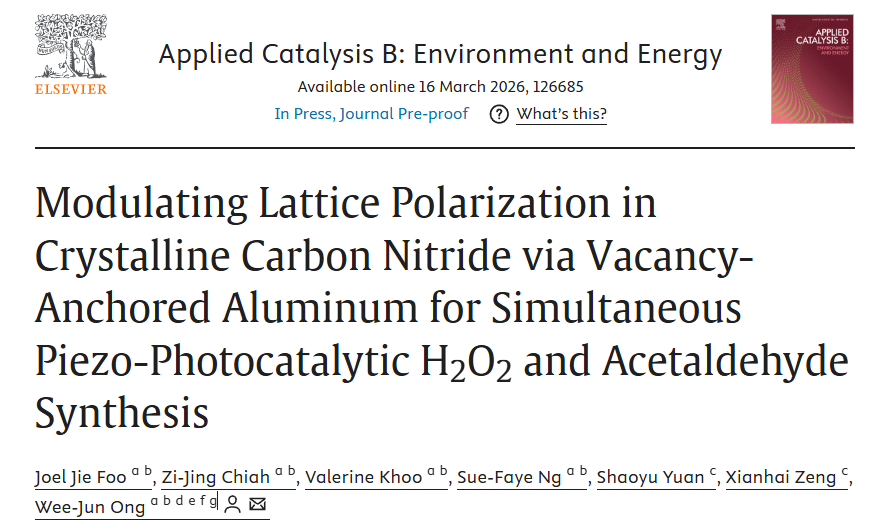
The full research article can be accessed online at https://www.sciencedirect.com/science/article/abs/pii/S092633732600305X
The graphical abstract of this research is shown below.